Jersey City Kitchen
A kitchen that reads as furniture
The kitchen is the most exposed room in the home. It faces directly into the living area without a partition wall, and a structural column at the edge of the layout draws the eye toward the cabinetry wall from the main entrance. Anything utilitarian about the kitchen (hardware, appliance edges, ventilation panels, reveal inconsistencies) would be visible from multiple vantage points throughout the day.
The homeowners' brief was clear on function: full-depth storage, integrated cold storage, an island large enough for prep and seating, and a stone surface durable enough for daily cooking. The tension was delivering all of that capacity while keeping the kitchen quiet enough to sit inside an open living space without dominating it. Every material selection and detail decision traced back to that single constraint.
Signature element: the slatted island
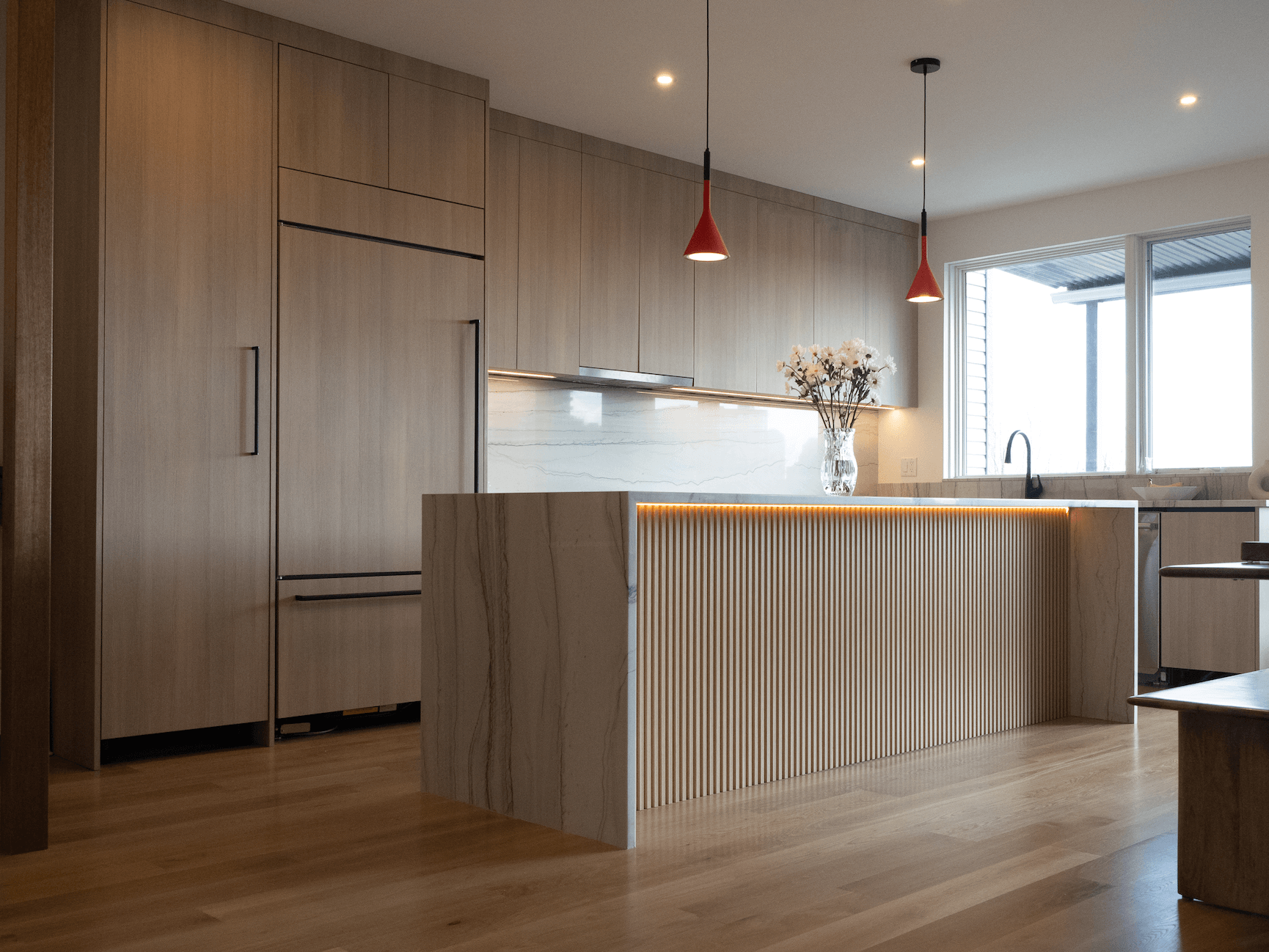
The island anchors the kitchen and establishes the project's material contrast: vertical wood texture against smooth, veined stone.
Wood Cladding
The front and back faces of the island are clad in individually routed vertical wood slats in a light-toned species consistent with rift-sawn white oak. Each slat was milled to a uniform width and fixed at consistent spacing to produce a controlled shadow pattern across the full length of the island. The slats terminate flush against the stone waterfall panels on both ends without baseboards or trim pieces, requiring close coordination between the millwork dimensions and the stone fabricator's final templating.
Stone
The countertop is a veined marble with diagonal figuring, mitered and wrapped down both short ends to the floor in a waterfall detail. The miter joints maintain grain continuity through each corner. The stone extends beyond the slat face on the seating side to create an overhang for bar stools, supported from below without visible corbels or brackets.
Integrated Lighting
A recessed LED channel is routed into the underside of the stone overhang, casting warm light downward across the slat texture. The channel housing sits within the stone edge profile and is not visible from standing or seated height. The lighting serves two roles: it washes the wood surface to emphasize the slat rhythm at night, and it provides ambient floor-level illumination that reinforces the visual separation between the heavy stone top and the textured base, producing a floating effect.
Scope Integration
The remaining millwork elements share the same veneer, hardware profile, and reveal tolerances as the island, maintaining a single visual language across the full kitchen.
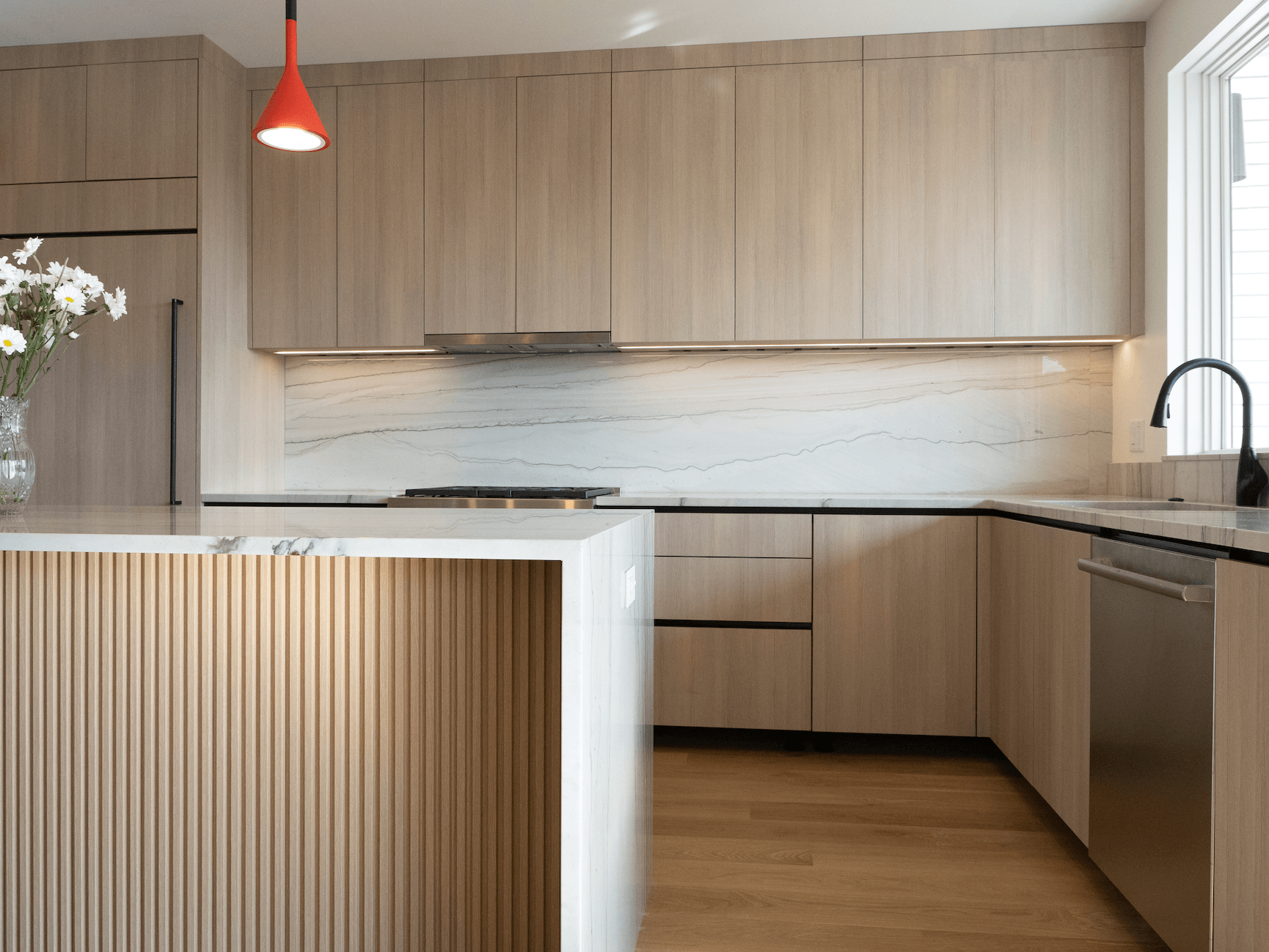
Perimeter cabinetry is frameless, full-overlay construction running floor to ceiling on two walls. All door and drawer fronts use a flat-panel profile with vertical grain orientation, which reinforces the height of the tall cabinet runs and standardizes the veneer application across different panel sizes. Edge-mounted continuous matte black pulls are used on standard cabinetry doors and drawers, tying visually to the black range dials, faucet, and sink hardware.
Panel-ready appliance integration conceals the refrigerator and freezer behind full-height veneer doors that match the adjacent pantry cabinets. The appliance panels use oversized rectangular matte black bar pulls (distinct from the edge pulls on standard cabinetry) to accommodate the heavier swing weight. Hinge boring was set to the appliance manufacturer's specifications to match the open/close resistance of the surrounding cabinet doors. The veneer on the appliance panels appears sequence-matched to the tall pantry doors beside them, preventing a visual break across the large flat surface.
Stone backsplash continues the countertop material up the wall in a single span between the upper and lower cabinets, eliminating grout lines behind the cooking zone. Under-cabinet LED strip lighting washes the stone surface, highlighting the veining pattern while providing task illumination at the counter.
Wood veneer: A light-toned species with linear grain (consistent with rift-sawn white oak) was selected for its ability to read cleanly across large, unbroken panel runs. Vertical grain orientation on all fronts creates visual continuity between the standard cabinetry, the tall pantry doors, and the appliance overlay panels.
Stone: The marble features prominent diagonal veining on the island countertop and waterfall ends, with a different linear veining pattern on the backsplash, creating a material connection between zones while allowing each surface to read distinctly. The finish provides a working surface suitable for daily cooking use near the range.
Hardware: Matte black throughout, in two profiles. Standard cabinetry uses continuous edge-mounted pulls; the refrigerator and freezer columns use oversized surface-mounted bar handles. The two pull types share a finish and geometric language but are scaled to their respective door weights and frequencies of use.
Fabrication: All carcasses and door panels were CNC-routed for dimensional accuracy. Hand finishing was applied at edges and joinery transitions. The island slats were routed on a dedicated jig to hold consistent width and spacing across the full array. Reveal sizing between adjacent doors, drawers, and appliance panels was held uniform across the entire kitchen.
Installation sequencing: Cabinetry was set and leveled first. Stone countertops and backsplash were templated on site after cabinetry installation to account for any wall or floor irregularities. Appliance panels were mounted and adjusted third. LED lighting (both under-cabinet and under-island) was commissioned last, with driver placement and switching coordinated with the electrician during the cabinetry phase.
The structural column
A freestanding wood column sits at the boundary between the kitchen and living area. The column is finished in a tone that matches the flooring rather than the cabinetry veneer, reading as a structural or architectural element rather than part of the millwork scope. Its vertical mass echoes the tall cabinetry wall behind it, while its distinct material identity helps define the threshold between the kitchen zone and the adjacent living space without a physical partition.